What is Google's MUM?
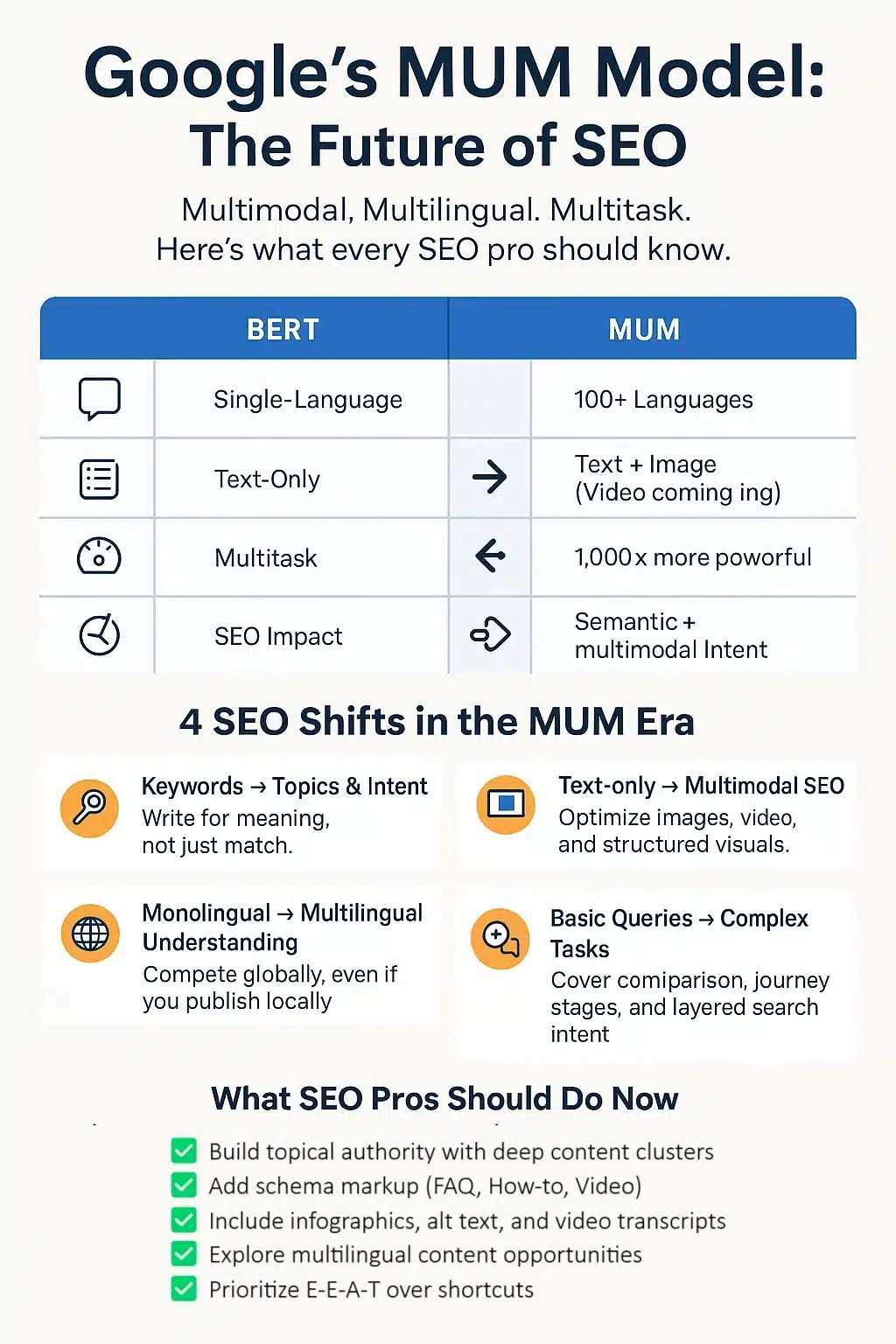
MUM stands for Multitask Unified Model, and it's designed to understand complex search tasks across different languages, formats, and modalities (like text, image, video, or audio).
Here's what sets MUM apart:
- Multilingual: Trained on 100+ languages to transfer knowledge globally.
- Multimodal: Processes information from both text and images, with plans to include video and audio.
- Multitask: Handles multiple tasks simultaneously—like understanding your query, pulling information from different sources, and generating meaningful answers.
Let's compare:
- BERT focused on understanding sentence structure and intent in a single language.
- MUM understands intent, emotion, and context—in multiple languages and formats—all at once.
That's not just evolution. It's a revolution.
MUM Is Rewriting the SEO Rulebook
Let's dive into how MUM is changing SEO and what it means for your strategy going forward.
1. Keywords Still Matter, But Context Is King
MUM doesn't need a perfect keyword match. Instead, it understands what people mean, even when their searches are vague, layered, or phrased like conversations.
Example:
Search Query: "What should I do after hiking Mount Kinabalu?"
A keyword-based engine might suggest more hiking gear or nearby trails.
MUM, on the other hand, understands you've completed a challenging hike and may be interested in similar but different activities, like cycling routes in Southeast Asia or mountain retreats in Sabah.
🔑 Takeaway: Focus on topical depth and semantic coverage, not just keyword density.
2. Multimodal Content Will Rank Better
Since MUM can understand and combine text, images, and soon even videos and audio, your SEO strategy must extend beyond written words.
That means:
- Optimizing alt text for images.
- Using video transcriptions.
- Embedding visual explainers that enhance user understanding.
If your blog includes an infographic that helps answer a complex question, Google may use that image content—not just your text—to determine rankings.
🔑 Takeaway: Treat your multimedia content as integral to SEO, not just as decoration.
3. Multilingual Content Just Became Global SEO Gold
One of MUM's biggest advantages is its ability to transfer knowledge across languages.
That means:
- Google can surface the best content to answer a query, even if it's not in the user's native language.
- A Japanese article explaining a complex medical condition could influence English SERPs—if it's more informative.
For international SEO, this is huge.
🔑 Takeaway: Optimize content for multiple languages and use hreflang tags properly. But even if you're focused on one region, high-quality foreign content can become your competition.
4. Intent Matching Now Requires Nuance
MUM doesn't just answer "what" a user wants—it considers "why" and "how".
That means:
- Search engines will expect content that answers multiple layers of intent.
- Your content should address comparison, recommendation, experience, and follow-up actions.
Think: Instead of a page that answers "What is digital marketing?", create content that also explains "How to start," "When to hire an agency," and "Common mistakes."
🔑 Takeaway: Adopt an intent-first content strategy—address multiple angles of the user journey in one helpful, organized page.
MUM In Action: Real-World Examples
Here's how MUM is already transforming search:
✅ Travel Search:
Ask, "What are the differences between hiking Mount Fuji and Mount Kinabalu?"
MUM can compare terrain, weather, gear, and skill levels—across languages and formats (even from Japanese YouTube videos or Malay blogs).
✅ Health & Wellness:
Search for treatment options across countries? MUM may pull multilingual results and combine them into context-aware answers—factoring in local practices, effectiveness, and cultural relevance.
✅ Visual Search:
Snap a photo of your running shoes and ask, "Can I use these for hiking?"
With MUM, Google can understand the image and your intent—then combine it with content that explains the difference between trail and road shoes.
What SEO Professionals Should Start Doing Now
Here's your MUM-proof action plan:
1. Build Topical Authority
- Create content clusters (pillar + supporting pages)
- Interlink naturally with clear hierarchy
2. Use Structured Data & Schema
- Help Google understand context, entities, and content type
- Use schema for FAQs, how-to guides, videos, and more
3. Incorporate Multimodal Content
- Use infographics, short videos, and descriptive images
- Optimize media files with filenames, alt text, and captions
4. Think Multilingual
- Even if you're not targeting global traffic, understand your multilingual competitors
- Explore opportunities in Malay, Chinese, or other regional languages